


Your shopping cart is empty!
Tomato "Red Robin"
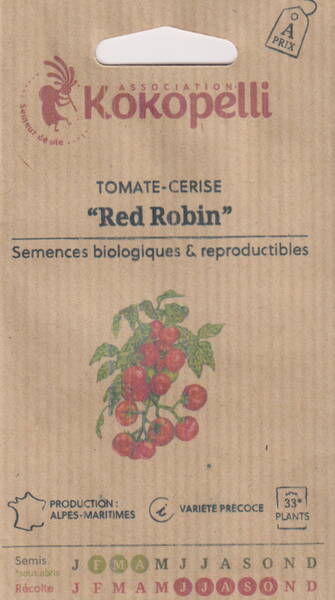
Eco seeds
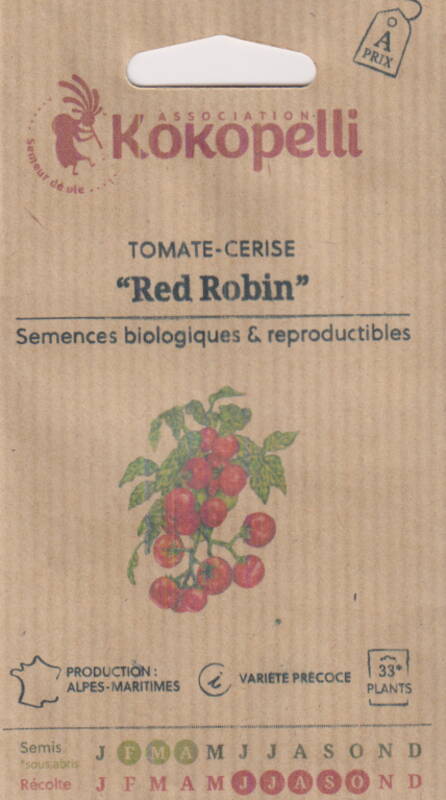
Tomato "Red Robin".
Covered in sweet fruits, a dwarf variety perfect for balconies and patios.
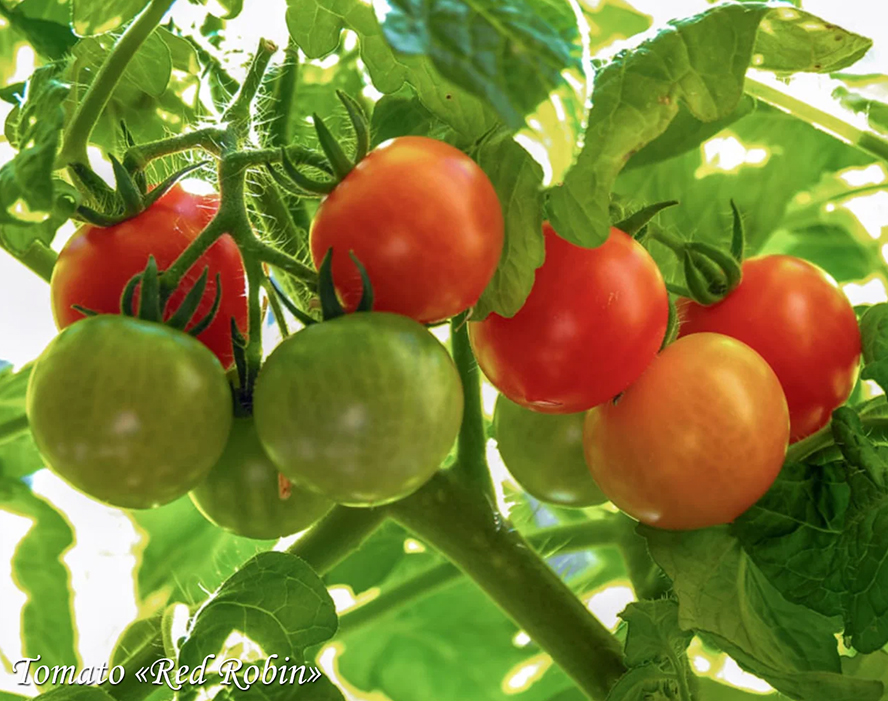
Super-early standard bush variety, 87-95 days from seedling emergence to ripening. The plant is compact, low-growing, 20-30 cm high, with small corrugated leaves, and looks very decorative — the plant is completely covered with fruits. The fruits are round, like little balls (2–3 cm in diameter), red, small, weighing 15-20 g, and sweet. Their firm, juicy flesh has a sweet, well-balanced flavor.
Recommended for growing on windowsills, balconies, loggias, outdoors in flower beds, and as a border plant. Great for phytocompositions. It can also be grown as a companion/filler crop in greenhouses.
The optimal soil temperature for seed germination is +26...+29 °C.
Texture: Juicy.
Growth Type: Determinate.
Plant Height: 20–30 cm.
Tomato Type: Cherry.
Foliage: Regular.
Covered in sweet fruits, a dwarf variety perfect for balconies and patios.
Super-early standard bush variety, 87-95 days from seedling emergence to ripening. The plant is compact, low-growing, 20-30 cm high, with small corrugated leaves, and looks very decorative — the plant is completely covered with fruits. The fruits are round, like little balls (2–3 cm in diameter), red, small, weighing 15-20 g, and sweet. Their firm, juicy flesh has a sweet, well-balanced flavor.
Recommended for growing on windowsills, balconies, loggias, outdoors in flower beds, and as a border plant. Great for phytocompositions. It can also be grown as a companion/filler crop in greenhouses.
The optimal soil temperature for seed germination is +26...+29 °C.
Texture: Juicy.
Growth Type: Determinate.
Plant Height: 20–30 cm.
Tomato Type: Cherry.
Foliage: Regular.
* Early blight or Alternariosis (synonyms: Macrosporiosis, brown leaf spot, target spot) is one of the most common and destructive tomato diseases. This disease affects tomatoes at various stages of development, starting from seedlings. It manifests on leaves, stems, and fruits. Massive disease development occurs at the beginning of fruit formation. The first signs of the disease are observed on the lower leaves. Gradually, the disease spreads to the upper foliage.
Round, concentric brown spots form on the affected areas, with an initial diameter of 4-7 mm. Over time, they increase in size, and the spots reach 10-15 mm in diameter. Their shape becomes oval, and a black, velvety coating appears on the surface.
Under favorable conditions, the expanding spots often merge and cover a significant part of the leaf blade. As a result, this form of disease progression leads to leaf death.
Petioles are also frequently affected: elongated spots appear on them, ringing them and leading to the death of the leaf blade. When stem parts (petioles, fruit stalks, shoots) are affected, elongated, sunken brown spots form on them, which become covered with a black velvety coating in damp weather, which represents the conidial sporulation of the fungus.
On fruits, disease symptoms are noticeable near the stalk, where round, dark brown, sunken, target-like spots with a grayish-black coating appear.
The pathogen's mycelium penetrates deep into the affected fruit. The infected tissue turns dark. Diseased fruits fall off, and some of them ripen prematurely. However, their mass is significantly lower than that of healthy ones.
Fruit infection during the ripening period is very dangerous, as the mycelium also penetrates the seeds. The seeds acquire a dark shade, and their sowing qualities drop sharply...
The causative agent of the disease is the fungus Alternaria solani Sor. (synonym — Macrosporium solani Ell. et Mart). This parasite develops in the conidial stage (black coating on the spots). During the plant vegetation period, conidia are spread by wind, rain, and irrigation water. The pathogen is also capable of parasitizing many other members of the Nightshade family — potatoes, peppers, eggplants, etc.
The development of early blight occurs in hot weather with light precipitation, at an air temperature of +25...+30°C. The disease progresses especially strongly when high daytime temperatures alternate with lower nighttime temperatures. Dew combined with frequent rain promotes abundant sporulation of the fungus. The presence of mechanical damage to plant tissues also contributes to their infection.
Under optimal conditions for the parasite, the incubation period of the disease is 2-3 days.
Older heirloom tomato varieties are often the most susceptible to early blight.
The sources of infection are plant debris, where the pathogen survives as mycelium and conidia on their surface, as well as seeds containing the pathogen's mycelium. In fully decomposed (composted) remains, the infection perishes and does not persist.
Protection.
* When growing tomatoes, preference should be given to hybrids and varieties with increased resistance to the disease. This helps increase yields and reduces the cost of protective measures.
* Seeds should be collected only from healthy plants and fruits.
* When preparing seeds for sowing, they must be thoroughly cleaned to remove all impurities, pieces of fruit, and other plant parts, as they can be a source of infection. Seeds are also treated with approved fungicides.
* Proper crop rotation, in which tomatoes are returned to the same plot no earlier than after 3-4 years.
* Considering that the fungus Alternaria solani Sor. also affects potatoes, try not to place these crops close to each other...
* It is also necessary to strictly observe agrotechnical practices for plant care in order to increase their resistance to diseases.
* In greenhouse conditions, it is necessary to maintain temperature and humidity regimes that would prevent the progression of early blight.
Vegetable salad "SUMMER".
Ingredients:
• 3 kg red tomatoes;
• 1.5 kg bell peppers;
• 1 kg carrots;
• 1 kg onions;
• half a glass of salt;
• half a glass of sugar;
• 1 glass of 9% vinegar;
• 1 glass of vegetable oil.
Preparation method:
1. Cut the tomatoes into 6-8 pieces.
2. Cut the onions and peppers into rings, and coarsely grate the carrots.
3. Layer the vegetables in a large basin, sprinkling them with coarse salt.
4. Let them steep for 24 hours in a cool place.
5. Drain the juice into a saucepan and prepare the marinade: add sugar, oil, and the remaining salt for every two glasses of juice, then heat to a boil.
6. Remove from heat, pour in the vinegar, and mix everything well with the vegetables.
7. Divide among jars, cover with lids, and sterilize for 10 minutes. Seal tightly.
Store at room temperature.